Uncertain Transport in Unsteady Flows
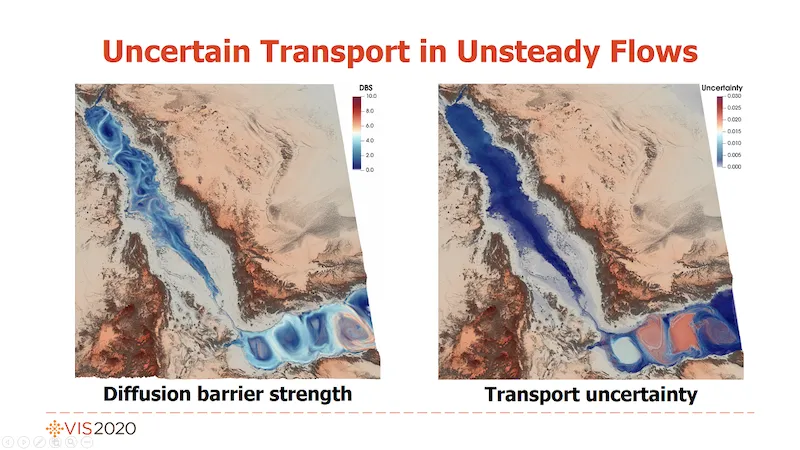
We model uncertainty in time-dependent flows with stochastic differential equations and identify surfaces that resist or enhance diffusive transport. The method avoids expensive Monte Carlo simulation while also showing the absolute scale of uncertainty, making the resulting flow structures easier to interpret.
Tobias Rapp and Carsten Dachsbacher
Proceedings of the IEEE VIS conference 2020.
Official version | Author’s version | Supplementary document | Supplementary code
Abstract
We study uncertainty in the dynamics of time-dependent flows by identifying barriers and enhancers to stochastic transport. This topological segmentation is closely related to the theory of Lagrangian coherent structures and is based on a recently introduced quantity, the diffusion barrier strength (DBS). The DBS is defined similar to the finite-time Lyapunov exponent (FTLE), but incorporates diffusion during flow integration. Height ridges of the DBS indicate stochastic transport barriers and enhancers, i.e. material surfaces that are minimally or maximally diffusive. To apply these concepts to real-world data, we represent uncertainty in a flow by a stochastic differential equation that consists of a deterministic and a stochastic component modeled by a Gaussian. With this formulation we identify barriers and enhancers to stochastic transport, without performing expensive Monte Carlo simulation and with a computational complexity comparable to FTLE. In addition, we propose a complementary visualization to convey the absolute scale of uncertainties in the Lagrangian frame of reference. This enables us to study uncertainty in real-world datasets, for example due to small deviations, data reduction, or estimated from multiple ensemble runs.